Showing posts with label Film Noir. Show all posts

Wednesday, June 4, 2008

Blade Runner


Kamala: Ridley Scott is either the most anal director ever, or the most dissatisfied with his studio's desired cut of his favorite film. There is an entire Wikipedia article dedicated to the SEVEN versions of Blade Runner out there. There is an "international cut," a "theatrical cut," a "director's cut," a "final cut," and more. We watched the american theatrical cut, reworked by the studio to be easier to understand and complete with a tacked on happy ending.

Emily: Kamala said she had seen this one before, but she had seen the grittier, pessimistic director's cut from 1992, with an entirely different ending. Similarly to Brazil, one of both of our favorite films, which everyone should see, Blade Runner was repeatedly bowdlerized by studio execs who failed to see the brilliance of the director's own devastating ending.

Emily: Blade Runner is the story of Rick Deckard's forced return from his self-imposed retirement from being a blade runner. In the near future (2019...I will be 29) a technology company has released an android, the Nexus 6, that is so close to being human that, when the replicants, as they are called, start to rebel against their human masters only certain, specially trained policemen can tell the difference between them and real people. These men are called blade runners. Deckard is forced back into his career to catch 4 replicants who are particularly dangerous. Their names are Batty, Pris, Leon, and Zhora.

Kamala: What I like the most about Blade Runner is the conflict between what is human and what isn't. Is Deckard any more human than Batty just because he was born, and not created? Isn't Rachel human because she believes herself to be? Is Deckard a replicant? Rachel's character shows that basically anyone can be a replicant, so what is the barrier of the knowledge available to a human about itself? This film is thoughtful and thought-provoking. Also, the futuristic view of Los Angeles is horrifying and yet realistic. An urban nightmare where most of the healthy people with at least some means are living in off-planet colonies, and those remaining on earth speak a strange street language cobbled together from Spanish, German, Japanese, and French.

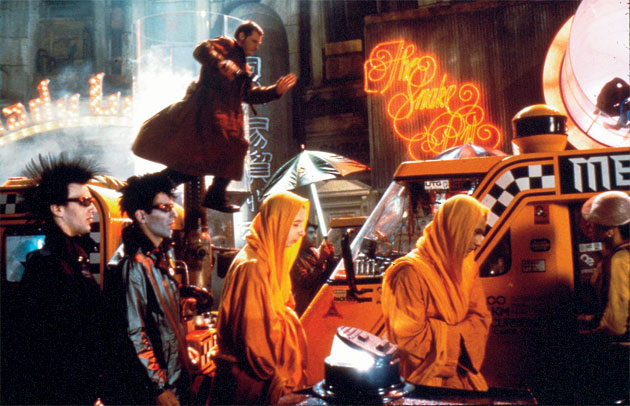
Emily: The world is a human tapestry of weirdoes. Hare Krishnas, Punks, Japanese thugs, etc.
Friday, May 9, 2008

Touch of Evil


"You're a killer."
"Partly. I'm a cop."

This exchange between two cops towards the end of the movie illustrates the moral struggle underlying the enforcement of the law. Vargas (Charlton Heston) asks Detective Quinlan (Orson Welles) who really has the ultimate authority--the cops or the law? In this film noir (the last we will probably watch) the ethical dilemma is between an american cop who frames the suspects he truly believes are guilty, and a mexican cop who tries to expose him in a quest for justice. 

The beginning of this movie is famous, and we both thought it was really cool. 
Kamala: It is a few minute long tracking shot starting with the placement of a bomb in the trunk of a car. 

Emily: The car moves in and out of the shot that switches focus from Charlton Heston and his pretty blonde bride and the oil magnate with his hooker driving the car. 

Kamala: It was ingeniously suspenseful. 

Emily: I really liked Marlene Dietrich as the creepy gypsy.

Kamala: She danced for Hitler. That is weird. 

Emily: She has this great line at the end though when a detective asks "Is that all you have to say about him?" she says: "What does it matter what you say about people?" I liked that.

Kamala: This is thought of as one of the last films of the "Classic" noir era, and that shows in its spare dialogue, ambiguous, almost bitter ending. One of the reasons Touch of Evil fits so well into our project is that it was produced through a large studio, Universal International, and director Orson Welles had trouble releasing his cut for that reason. The DVD came with a preface that after the studio showed him their final cut, Welles wrote a 55 page memo explaining how his artistic integrity was compromised. The version we saw was the closest available to Welles' desired cut. Basically the trouble with this movie shows what Kiss Me Deadly was able to avoid by working under United Artists.

Emily: It was funny the way they talked about the "reefer." And "mainlining" dope? I had no idea that it was possible to mainline "reefer." The narcotics subplot was cute. 

Kamala: Also we had to put subtitles on like 15 minutes in because Orson Welles was INCOMPREHENSIBLE! He sounded like Weelll sheee ii dont shsnoww ifff youuur. He had balls in his mouth. 
Also Charlton Heston plays a mexican...


Thursday, May 8, 2008

Kiss Me Deadly


We wanted to watch this movie, because  it was produced by United Artists, and  because it is known for pushing the conventions for movies of the 1950s with its violence and sexuality. There is even a scene of implied vaginal torture with pliers, and a woman on fire. It wasnt the freshest or most suspenseful movie, but it had its merits, a rather interesting film noir plot complete with anti-hero and attractive floozies.

United Artists was essentially the first "independent" film studio, established by actors and directors in 1919 as a way to better control their artistic expression and their salaries. In the 1950's in an attempt to increase profits, United Artists began giving money to independent producers rather than working as a consolidated studio. This allowed the producer of Kiss Me Deadly, Robert Aldrich, who was also the director, to have more freedom over his picture than he would at a large, controlling studio much like what United Artists has become today under the iron fist of Mr. Tom Cruise. This film fits into our project as a independent counterpart to All About Eve with a relatively unknown cast.

Filmed in 1954, of course during the cold war, the theme of nuclear apocalypse is shocking. Tellingly, in the scene where the FBI agent tells Mike Hammer, the main character, that the much ado is over something having to do with the "manhattan project," Mr. Hammer, usually combative with cops, calmly cooperates.

Kamala: Kiss Me Deadly is also interesting because it influenced some independent cult films we will watch later in our project. The glowing suitcase filled with "the great whatsit" device shows up in Pulp Fiction, and Repo Man. Raiders of the Lost Ark too.

Emily: I thought the camera angles were fantastic. Very unconventional.

Robert Aldrich produced this film through his own studio, not completely under the wing of United Artists, giving him a little more freedom.

The female character Mike encounters in the beginning refers to women as "the incomplete sex," paralleling Bette Davis' speech on how women aren't women until they have a man. Clearly, this was a prominent theme in the 1950's.

Emily: This film was replete with semi-offensive caricatures of immigrants, incoherent street lingo (va-va-VOOM was one of my favorites) and tough-guy violence. It's great pulp cinema, even if it takes a while to figure out what's going on.