
Here is list of all the movies we watched, by decade!
The 1950's!
All About Eve, Kiss Me Deadly, Touch of Evil, Julius Caesar, High School Confidential!, Lost Lonely and Vicious
The 1960's!
Easy Rider, Cleopatra, The Cut-Ups, Towers Open Fire, William Buys a Parrot, Dynamite Chicken, Take the Money and Run, Bonnie and Clyde
The 1970's!
M*A*S*H, Taxi Driver, THX 1138, Jaws, 1941, Apocalypse Now
The 1980's
Blue Velvet, Blade Runner, Do The Right Thing, Repo Man, Tootsie
We also watched a film called Drive, He Said, which Mr. Turner would not stop recommending to us. He even gave us his personal VHS recorded in like the late 80's off Cinemax. Spoiler Alert!: The movie was weird.
Thanks for reading!
Thursday, June 12, 2008

Friday, June 6, 2008
Tootsie
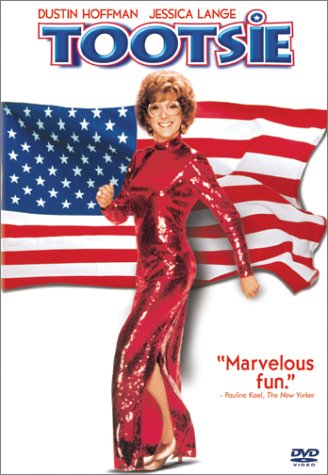
Tootsie is the adorable story of an out of work actor's, Dustin Hoffman, attempts to find work in New York City. When he can't make it as a male actor, he dresses up like a woman and gets a job on a General-Hospital-like soap.
Emily: I had seen this before and we wanted to watch something cute because Do the Right Thing was sad, Repo Man was weird, and the cocktail of disturbing that was the combination of Blue Velvet, Apocalypse Now, and Blade Runner all in a row was a little much for the two of us.
Kamala: Tootsie is an adorable light-as-air comedy about a man trying to make it as a female actor in NYC. It isn't one of those movies that you praise artistically afterwards, but it was fine, I mean it was cute. We hadn't watched enough of those typical big studio movies in the 80's and so we decided to watch this one. It was produced by the now-late Sydney Pollack. He cast Bill Murray as Hoffman's roommate. IMDB says that all of his lines were improvised but I don't think that is such a feat because he basically said the same thing with the same annoying deadpan face every time. Like "this is getting creepy Michael" or "do you want help with that brassiere?"
Emily: Oh snap
anyways Tootsie was also jolly redhead giant Geena Davis's film debut. Dustin Hoffman and Sydney Pollack worked closely together to make this film. The idea came to Hoffman to play both a man and a woman while working on Kramer vs. Kramer, which is a good movie just so everyone knows. We don't really have much to say about this one, it was one of those PG sightly racy family comedies and Dustin Hoffman is an unbelievable jerk to this woman he is working on a play with as "Michael." I mean Kamala and I had to pause the movie to make sure that he really had just I mean he was horrible. Tootsie is adorable, as we have said, and if you are looking for something light and happy to watch in between films about a robot apocalypse, apocalypse now, and a small town gangster/pervert, Tootsie is the film for you!
"No one ever laughed during the shooting of any scenes of the film. It's only funny because of its story structure." -Sydney Pollack

Thursday, June 5, 2008
Repo Man

Kamala: Repo Man is this weird independent cult film from 1984. It is about this 18 year old punk from LA who becomes a repo man when Bud, a veteran repo man played by Harry Dean Stanton, tricks him into repossessing someone's car and taking it to their lot.
Emily: This movie made no sense to me. I had to keep pausing it so Kamala could explain things. Emilio Estevez is the young disillusioned punk kid who becomes a repo man, there were a lot of car chases and people getting fried by the radiation (the neutron bomb, which vaporizes people but not buildings) from the trunk of the Chevy Malibu. Speaking of that-the glowing trunk of the car is probably an homage to the glowing suitcase that set people on fire from Kiss Me, Deadly. Repo Man brought its director, Alex Cox critical acclaim and it's cited as one of the first contemporary independent movies. The fact that it wasn't a very "deep" movie (a fact that Kamala had to keep reminding me of) did not at all take away from its enjoyability.
Kamala: This movie has become a cult classic because it's full of aliens and stuff about time travel, and also humorously portrays the LA punk scene of the 1980's. The conceit of labeling all the food and drink as exactly what it was (Cereal simply marked "Cereal," beer labeled "beer," etc) is neat. There are a lot of interconnecting motifs in this movie. One example of this is one man in the Repo yard talks about how if one person is thinking about a plate of shrimp, another person will say "plate" or "shrimp" or "plate of shrimp." And these words appear a lot throughout the film.
Emily: Practically every character in this movie appears more than once, even very minor characters like Otto's friend Kevin. This movie is just choc-full of weird stuff that only really attentive people or people who have seen it more than once can really pick up on-something I noticed though, is that whenever we see a car making a turn, it signals the opposite direction.
Kamala: The soundtrack is made up of really awesome punk songs and the score is fairly reminiscent of Tarantino and I really want it so I can listen to it in my car.
Emily: I think the movie had a lot to do with the punk movement. Alex Cox directed Sid & Nancy (a movie about Sex Pistol's bassist Sid Vicious and his relationship with Nancy Spungen). The Circle Jerks, a rather famous California-based punk band, appear in a lounge scene. Also Black Flag has several songs on the soundtrack.
Kamala: Like Paul Schrader (who worked as a taxi driver and based his screenplay off of the experience) Alex Cox worked as a repo man in LA and based the screenplay off of some of his experiences. This movie is definitely worth watching if you're into odd sci-fi cult movies.
Emily: Pretty crazy.
Do The Right Thing

Kamala: I'm glad that Emily liked this one. Although it was no surprise to me as the Symington family has close ties to the black community. In fact, her brother won the DC African-American history bee two years in a row.
Emily: Ha. Actually though this movie is great. It is culturally significant, dealing with race conflicts in the Brooklyn neighborhood of Bedford-Stuyvesant. Its centers on Mookie, played by Spike Lee, a young father working as a pizza delivery boy for an Italian-American owned neighborhood pizzeria. The majority of the film, like an hour and 45 of two hours, takes place entirely on one extremely hot summer day.
Kamala: It was really well shot. There were a lot of really interesting angles, especially one shot of Mookie walking over a little girl's chalk drawing in the street. The colors also were intensified in a way that made you really feel how how it was supposed to be. I also liked the motif of having Public Enemy's song Fight the Power playing from a boombox. It gave a realistic sense of being in this two or three block neighborhood with the same people walking in and out of your awareness. I don't know how to say that without sounding a little silly...
Emily: This film was extremely controversial when it was released. In the news it was impugned as a vehicle to incite poor black neighborhoods to riot. It also received a LOT of critical acclaim, being nominated for two academy awards and the palme d'or at Cannes to name a few. This film fits perfectly into our project because Spike Lee is a great example of one of those independent directors that emerged in the late eighties.
Kamala: The early eighties were overrun with big studio abominations and the lack of good movies out there plus increasingly available VHS home movies made it easy for anyone, not just film students, to become familiar with older films. Many of these directors were able to produce extremely new and interesting films such as Do the Right Thing, Repo Man, or, moving into the early nineties, Reservoir Dogs. Also, it was becoming easier and cheaper for people to have access to recording and editing equipment, allowing for lots of low-budget movies to be made and released by new filmmakers.
Emily: Do the Right Thing is a fresh, extremely moving film that stays with you.
Wednesday, June 4, 2008
Blade Runner

Kamala: Ridley Scott is either the most anal director ever, or the most dissatisfied with his studio's desired cut of his favorite film. There is an entire Wikipedia article dedicated to the SEVEN versions of Blade Runner out there. There is an "international cut," a "theatrical cut," a "director's cut," a "final cut," and more. We watched the american theatrical cut, reworked by the studio to be easier to understand and complete with a tacked on happy ending.
Emily: Kamala said she had seen this one before, but she had seen the grittier, pessimistic director's cut from 1992, with an entirely different ending. Similarly to Brazil, one of both of our favorite films, which everyone should see, Blade Runner was repeatedly bowdlerized by studio execs who failed to see the brilliance of the director's own devastating ending.
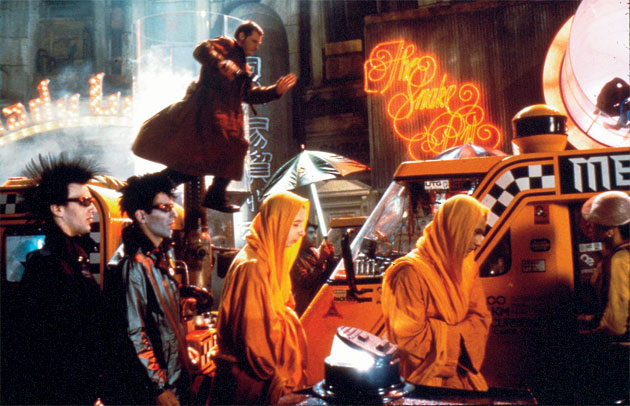
Emily: Blade Runner is the story of Rick Deckard's forced return from his self-imposed retirement from being a blade runner. In the near future (2019...I will be 29) a technology company has released an android, the Nexus 6, that is so close to being human that, when the replicants, as they are called, start to rebel against their human masters only certain, specially trained policemen can tell the difference between them and real people. These men are called blade runners. Deckard is forced back into his career to catch 4 replicants who are particularly dangerous. Their names are Batty, Pris, Leon, and Zhora.
Kamala: What I like the most about Blade Runner is the conflict between what is human and what isn't. Is Deckard any more human than Batty just because he was born, and not created? Isn't Rachel human because she believes herself to be? Is Deckard a replicant? Rachel's character shows that basically anyone can be a replicant, so what is the barrier of the knowledge available to a human about itself? This film is thoughtful and thought-provoking. Also, the futuristic view of Los Angeles is horrifying and yet realistic. An urban nightmare where most of the healthy people with at least some means are living in off-planet colonies, and those remaining on earth speak a strange street language cobbled together from Spanish, German, Japanese, and French.
Emily: The world is a human tapestry of weirdoes. Hare Krishnas, Punks, Japanese thugs, etc.
Blue Velvet

Blue Velvet was one of the independent movies released in the 1980's by a very interesting, very deranged director, David Lynch. It is the story of a small town college graduate named Jeffrey Beaumont who, after finding a severed human ear in a field, mixes himself up with a lounge singer who is being victimized by a local thug/drug lord/sex pervert. Most of the movie isn't exactly school appropriate so we aren't sure how to talk about this one.
Kamala: But first, background. David Lynch directed Eraserhead in the late 70's. It caught the attention of Mel Brooks, and he was given money to make The Elephant Man. The film was a critical success, and Lynch was contracted by Dino De Laurentiis to film a version of Frank Herbert's Dune. Lynch agreed to do it on the condition that he would be allowed to film another movie however he wanted to. That movie was Blue Velvet. He has later described it as his most personal movie, dealing with his childhood in the small town of Spokane, Washington. This movie was set in Lumberton, North Carolina which is funny because I've been to Lumberton.
Emily: I like David Lynch movies generally, especially Mulholland Drive. This one was a little slow at first, but much much easier to understand. He did not eschew narrative continuity. Blue Velvet is credited with revitalizing Dennis Hopper's career, and he is rivetingly great as the sociopathic murderer. Also Kyle MacLachlan has a role in Desperate Housewives.
Kamala: That's too bad. From David Lynch movies to Desperate Housewives. Also he looks exactly, EXACTLY like a young Jon Zeljo, which is pretty scary considering like some of the stuff that he does in the film. Yet also strangely fitting....
Emily: Except for not, because Desperate Housewives is awesome....
Kamala: I generally like movies that have a lot of awesome bright colors and light. The opening sequence was a shot of brightly red roses in front of a white picket fence, in front of a strikingly blue sky. It looked like one of those Salvador Dali paintings of roses in the sky, beautiful.
Emily: I liked that shot too. The use of Roy Orbison's song "In Dreams" was great, as well as the titular pop song "Blue Velvet."
Kamala: I have "seen" one other David Lynch movie, his newest called Inland Empire, and let me tell you, Blue Velvet was far more enjoyable. For one, I saw most of the Inland Empire's three hours through my fingers because it was absolutely terrifying. Moreso, it was virtually plotless, centering on Laura Dern, one of Lynch's favorites who plays a teenager smitten with Jeffrey in Blue Velvet, but occasionally drifting in and out of Rabbits, Poland (?), and reality. Blue Velvet on the other hand was intensely watchable. The villain was despicable, disturbed, and well acted, the femme fatale/victim was suitably messed up in the head, and the main character was one of the most morally conflicted I had ever seen. He alternated between sweet, naive, creepy, driven, and pseudo-rapist personalities.
Emily: This movie was amazing and I recommend it highly.

The 1980's

The legacy of the 1970's left on American film was the public's acceptance of more graphically realistic depictions of sex and violence. Enter directors like Ed Wood, John Waters, and David Lynch. We think it would be incomprehensible for someone like Lynch to make a movie that could win an Academy Award in the 1960's or even the early 1970's. The Elephant Man is like, well, an elephant while Easy Rider, which was controversial for its time, is like something a lot smaller than an elephant. The 1980's also saw a flourishing of actual independent films, rather than "independent" studios like American Zoetrope that worked inside the system financing directors with interesting visions. The formation of Robert Redford's Sundance Institute helped to finance many independent directors like Jim Jarmusch, Gus Van Sant, Stephen Soderbergh, and more especially in the early 1990's. Which we won't get to. But who cares. Spike Lee, Quentin Tarantino, Kevin Smith, and others released independent films towards the end of the 1980's and into the early 1990's. They were called the video generation because, due to the increasing availability of VHS home videos, they were able to amass huge libraries of movies from all over the world that would influence their work. This can be seen in the large number of references to other films, such as Kiss Me Deadly for example, in Tarantino's work.
The studios lost money in the 1980's too perhaps because of all the crappy blockbusters that Kamala hates that they made or perhaps because of all the cool independent movies coming out that were pretty available for viewing.
Tuesday, June 3, 2008
Apocalypse Now

Kamala: Uh
Emily: This is one of my all-time favorite movies. Kamala had never seen it before though, and she's still in shock. She generally avoids movies about the Vietnam war. In case you are a loser and you've never seen Apocalypse Now, it's a film directed by Francis Ford Coppola, loosely based on the Joseph Conrad novel, Heart of Darkness. It stars Martin Sheen as a Captain sent on a mission to terminate the command of one Colonel Kurtz, who has gone insane and retreated into the jungle of Cambodia with a small army of Vietnamese, Cambodians, Laotians and Green Berets who worship him as a god.
Kamala: The entire film was visually striking. I can only imagine what their budget was like. Between the napalm attacks, helicopters, other random stuff that got blown up, and large amount of extras the entire production was of epic proportions. We read on IMDB trivia that the movie was shot over 16 months, mostly in 1976, but not released until 1979 because of the amount of time it took to sort through and edit the over 200 hours of footage that Coppola shot. The editing team's efforts show in the flawless cinematography. There are some films where you are taken out of the story by some weird cut or something that makes you remember you are watching a movie. The only thing that made me remember I was watching a movie was that my Grandma called in the middle.
Emily: Something I hadn't noticed before is that there are no starting credits-no title appears onscreen at the beginning, it just goes straight in with the footage of Martin Sheen's face and jungle burning to The Doors' "The End." At Kurtz's compound, however, the words "Our motto: Apocalypse Now" are seen on a wall. This was put there so the movie could be copyrighted.
Kamala: In terms of cultural importance, this is one of the films (similar to 1941) that made studios want to take some control away from the dirrectors. Coppola took some men into the jungle, subjected them to shooting an emotionally and physically devastating film and came out of the jungle 16 months later with no footage they could use for three years. The actors were genuinely feeling the emotions of their characters. Lawrence Fishburne was actually younger than he should have been during filming, just as he was on the navy boat in the backwoods of Vietnam. Martin Sheen has a scene at the beginning of the movie where he gets drunk, punches a mirror and trashes his room naked was, in actuality, REAL. And there was a real cow sacrificed.
Emily: The dialogue is also something that stays with you long after the movie ends. The voice of Marlon Brando at the beginning of the film ("I saw a snail crawl across the edge of a straight razor. This is my dream. This is my nightmare") haunts the viewer as much as it haunts Sheen's character. Pretty much any scene with Robert Duvall as Captain Killgore is funny in a terrible way- the contrast of the conversation (about surfing, mostly) and the surroundings is absurd. But the movie gets progressively more horrific the farther they get into the jungle. This movie is incredible, and is undeniably the best war movie ever filmed. Nothing even comes close. At the end Kamala and I were silent for about five minutes because honestly what can you say after you've just watched something like that?
Kamala: Oh the horror, the horror.
or schadenfreude, whichever you prefer.

1941

1941 is a Stephen Spielberg action farce about a Japanese attack on Hollywood.
Emily: Sounds great right? Ha ha wrong it sucked. The entire film was like one of those interconnected lives movies where, at the end, all the stories come together, but instead of it being a good example of a film like that (such as Magnolia) it was crappy. The whole premise was that a Japanese submarine, left out of the glory of the attack on Pearl Harbor, sailed (is that the right word for a submarine?) to Los Angeles to try and annihilate Hollywood. The Japanese, led by Akira Kurosawa's favorite Toshiro Mifune, bumble along
Kamala: In a fitting tribute to Jaws, the opening scene was the same actress who played Jaws' first victim skinnydipping at night and ending up stuck on the top of the surfacing submarine's periscope. I say fitting because Jaws' success in box offices across America led to the drive to create movies like this. Interestingly enough, this was one of the movies that helped to make studios realize that maybe they shouldn't give their directors all the freedom in the world. The film was intended as a blockbuster, but really did rather poorly at the box office.
Emily: It was one of those "action-packed" appetite for destruction movies where the last 30-40 minutes consist of the plain and simple destruction of everything possible on the set. Movie theatres, airplanes, gas stations, cars, tanks, ferris wheels, there is even a shot of an entire house falling off a cliff. I am not a person who hates action films, but this was excessive and pointless.
Kamala: I thought it might be funny because Dan Aykroyd was in it and I generally think he is a pretty cool guy, but there was little humor that wasn't that kind of unfunny crude stuff.
1941 is a perfect example of the difference between the interesting films of New Hollywood that pushed the envelope in at least some way, and the schlock produced by studios during the blockbuster boom of the late 1970's.
JAWS!!!!!!!!!

Jaws is the awesome tale of an epic battle between men and a primordial beast. When an absolutely gigantic Great White shark starts preying on the beaches of Amity Island, a summer beach community that seems based on, and was filmed at, Martha's Vineyard. The greasy mayor of the town won't let the wet behind the ears sheriff close the beaches, his greatest source of income, to cut off the shark's food supply. After a few local fishermen's misguided attempts to catch the monster, three men, the sheriff, a salty fisherman, and a shark enthusiast from the "oceanographic institute," set out in what is perhaps too small of a boat to search and destroy Jaws.
This movie is epic. The first scene is epic, the middle bits are pretty epic, and the end is certainly epic. It also isn't a crappy movie. In fact, this movie is considered to be the dividing line between New Hollywood, and the blockbusters that dominated the late seventies and really, continue to dominate movie theaters today.
What is a blockbuster you ask? Technically, a blockbuster is a film that makes over $100,000,000. Jaws was the first movie in history to make over 100 million. But, I want to use the term to mean a film that was created with the intent of making huge amounts of money in the box office. These movies, in my elitist opinion, can easily turn into high budget monstrosities designed for mass appeal. Let's look at the top films in the box offices right now. Indiana Jones and the Kingdom of the Crystal Skull, the latest installment in a franchise started by Lucasfilm and Spielberg in the eighties, has fallen behind the Sex and the City movie, which I don't want to profane because I will probably see that tonight but is an obviously artless ploy for box office success. Ironman, The Chronicles of Narnia: Prince Caspian, Speed Racer, Made of Honor, it is summer so pretty much all of the movies out now are "blockbusters" in the sense that they don't seek to advance the art form, only to gross as much money as possible. Jaws was followed by The Omen and Star Wars, two movies that, especially Star Wars, made just oh so much money.
Jaws was a great, smart movie with a gripping plot and awesome action. It made so much money in the box office that studios started to want to make more and more and more movies with similar templates: relatable characters, lots of action, and at least one naked woman, like the thousand sequels Universal tried to make, including Jaws 2, Jaws 3-D, Jaws: The Revenge, and Jaws Unleashed (which is a video game but whatever).
All that said, I love Jaws, and anyone who hasn't seen it should watch it unless you are Emily, who refused to watch this with me, and have an actual, diagnosable phobia of sharks.
-Kamala

Monday, June 2, 2008
THX 1138

This movie was George Lucas' first. He adapted it into a full length feature from a short film he made in film school. THX 1138 is the story of the titular character's life in a strict futuristic dystopian society. Sex is outlawed, and mind-controlling drugs are administered forcibly. THX, Robert Duvall's character, and his "roommate" LUH fall in LUHve...
Emily: I'd like to let the readers know that Kamala made that joke just now, not I.
Kamala: Anyways, lets strip away the pretensions here, I'm the one who writes the intros so from now on I'll just attribute it to me. THX, Robert Duvall's character, and his "roommate" LUH fall in love and are jailed for drug evasion (they stop taking their required sedatives) and sexual perversion (because they start actually having sex).
Emily: The role of the movie's other main character, SEN, confused me. He is turned in by THX because he hacked into the computer system to try and switch roommates. He wants THX to be his roommate and it's never really made clear why. In the 2004 re-mastered DVD release of this film, George Lucas made the ties of the three characters (LUH, THX and SEN) more obvious by having LUH and SEN work in the same place monitoring camera footage of houses, and adding footage of SEN and LUH exchanging a meaningful glance when they catch a couple engaging in illicit sexual activity. He escapes from prison with Robert Duvall but they get separated and SEN completely loses it and goes to pray to the state-sponsored deity OMM. I did not get him...
Kamala: The religious aspect was quite interesting. There were numerous scenes where THX would go to one of these confessional booths that had a portrait of Jesus and a recorded voice that spouted platitudes such as "yess...goood....everything will be fine...you are a true believer" etc. I also want to talk about the overall look of the film. I thought it was awesome. The set was white and geometric, with little color. All the regular people wore white and were bald. Their entire society was based on dehumanizing its constituents, through drugs, suppression of sexual instinct, lack of names, and homogeneity. George Lucas did an excellent job of creating this dystopian world. The only strange thing was that about halfway through we noticed some of the special effects were very very very good for 1971. Turns out that the version we watched was the Directors Cut, and Lucas had re-mastered a lot of the special effects.
Emily: Kamala really dislikes the ending. The police stop chasing THX because they've gone too far over the "budget" for re-capturing a felon. Robert Duvall emerges from the shell surrounding the city into a setting sun, with choral music playing over the scene. She said it was corny and cliche. It didn't bother me as much, but it did seem somewhat anti-climactic since the whole rest of the movie was so great.
Kamala: It was cool to see the development of Star Wars in Lucas's earliest film. Some of the very geometric shots of people walking through white hallways looked just like the hallways in Lando's Cloud City.
Emily: Also they called something a Wookiee. I didn't catch exactly what it was referring to but the word was definitely used.
Kamala: Basically this was an awesome sci-fi movie, a beautiful film, and gave you a little something to think about afterwards. I am a huge fan of dystopias of any genre, and THX 1138 reminded me a lot, of course, of some of my favorite dystopias: We, Brave New World/Island, 1984, and Brazil, a film that EVERYONE should see. I would highly recommend THX 1138 to anyone.
Friday, May 30, 2008
Taxi Driver

Because we had both seen this one before, we were able to watch it a little more critically than a first-time viewer. Taxi Driver is the story of an alienated young Vietnam vet driving a Checker Cab in New York City. When he is rejected by the girl he takes to a porno on their date, he goes off the deep end and vows to rid the streets of NYC of all the scum.
Emily: Apparently the screenwriter, Paul Schrader, based the character of Travis Bickle on himself. While living in Los Angeles, he had a nervous breakdown, became really depressed, didn't talk to anyone for weeks, and developed an obsession with guns. Just a little trivia courtesy of imdb.
Kamala: This movie was shopped around by Shrader to a lot of studios, and Columbia took it with the package deal of Scorcese and DeNiro. After seeing Mean Streets, the tale of an epileptic mobster, Harvey Keitel, and his crazy cousin, DeNiro, the studio execs really wanted another Scorcese and DeNiro collaboration. Thank god because the other options for Bickle, according to wikipedia, were like Neal Diamond and Jeff Bridges......
Emily: Travis' monologues describing NYC as an "open sewer," the scene with Martin Scorcese in the back of the cab talking about shooting his wife in the face with a 44 magnum, and every scene shot with Harvey Keitel as the gross child-raping pimp build on the themes of urban decay coupled with the loneliness and isolation of post-Vietnam America. Robert DeNiro's character wants to make his mark on the world, (spoiler alert!) even attempting to assassinate a New York senator-the irony of the ending is that this man is hailed as a vigilante hero when really he's just an unhinged killer. America's fascination with folk heroes never ceases to astonish me.
Kamala: Yeah like Mr. Turner told us this story today about some horned toad called Old Rip that was buried in a corner stone in some building, and years later, when the building was demolished, they found the toad and it was alive!!! They even took it to meet Calvin Coolidge. Bizarre.
Emily: How does that have anything to do with folk heroes?
Kamala: It's got to do with American mythologizing. It's because the toad was underneath a Bible that it survived and it was such a big deal.
Emily: I'm not sure Peter Boyle can be anything but Frankenstein's monster in any movie he has a role in. I look at him and it's all I see. He has a small role as a cabbie.
Kamala: Jodie Foster is great for the role of the baby prostitute because she looks really young but sounds old.
Emily: The movie is really all about Robert DeNiro and his jacked body doing clap push-ups. Rocky won out over this movie for Best Picture in 1976, but watch the scene with DeNiro doing clap push-ups and you will be just as inspired to be the best you can be!
Thursday, May 29, 2008
M*A*S*H

Robert Altman made M*A*S*H in 1970 to resemble Vietnam in all ways possible. The studio however, made him preface the film with quotes from Douglas MacArthur and Eisenhower, dating the film to the Korean War. In fact, the studio made him do a lot of things for this movie. Altman is quoted as saying that the film "was not released, it escaped." He experienced troubles akin to those Orson Welles had with Touch of Evil. 20th Century Fox was coming off some serious losses in the late 60's (Cleopatra anyone?) and was not going to take a chance on finicky artists: they had an iron grip on everything coming out of their studio. Despite all of this, M*A*S*H was the first major studio movie to use a certain profanity that rhymes with "duck."
Emily: I really liked this movie even though I was initially skeptical about watching it. Kamala has seen it about 10 times. Donald Sutherland is amazing and it's a shame Robert Altman didn't cast him in any subsequent movies.
Kamala: Apparently Elliot Gould and Donald Sutherland had some complaints about Altman, and only Gould apologized. Robert Altman cast him in The Long Goodbye; thankfully, because that movie is really good, but Altman never worked with Donald Sutherland again.
Emily: I thought the film was an entirely realistic slice of life type portrayal of a few months (I never figured out exactly how long it was...) in the lives of surgeons in the 4077th Mobile Army Surgical Hospital. Robert Altman has this technique where he doesn't just focus in on two or three characters reciting a script one after the other, the camera sort of just observes often large groups of people with two or three layered conversations going on at the same time. For instance, in the operating room there would be three separate quiet conversations that a constantly moving camera would switch between. I really liked his style as a director.
Kamala: IMDB movie trivia says that 80% of the dialogue was improvised, which helped to make it seem more realistic. Each actor really was his or her character. Altman also trolled small time improvisational clubs for actors, wanting normal looking unknowns, making for the incredibly long list of "introducing so and so"'s in the credits.
The 1970's!
The 1970's were an interesting time in American Film. As we have said in earlier posts, we want to focus on the larger studio films created by the "New Hollywood" generation of filmmakers. The 1970's saw the flourishing of young, film school educated directors who were given substantial artistic control over the films they created for large studios. However, in no way were George Lucas, Scorcese, Speilberg, Woody Allen, Coppola, and other new hollywood directors independent filmmakers. Their films often resembled independent films in terms of language, violence, sexuality, and theme. Taxi Driver, which we will watch later, is a good example of a film that, because of its extreme violence and misanthropic anti-hero, can seem like an independent film, yet was not by any means. The new hollywood directors blurred the line between independent and big-studio films.
We also want to examine the transition from innovative new hollywood films to the hollywood blockbusters that seem to come a dime a dozen nowadays.
We also want to examine the transition from innovative new hollywood films to the hollywood blockbusters that seem to come a dime a dozen nowadays.
Wednesday, May 28, 2008
Bonnie and Clyde

This is the last movie we will watch in the 1960s. Bonnie and Clyde is the true story of a couple who robbed banks during the Great Depression. "Times is hard" and Clyde Barrow and Bonnie Parker turn to burglary in order to make ends meet. Bonnie Parker is played by the (strangely) beautiful Faye Dunaway (who is less weird looking in this film than in Chinatown) and Warren Beatty plays Clyde Barrow.
Emily: This movie focuses a lot on the relationship between Bonnie and Clyde but it also serves as a metaphor for tensions in American society during the Great Depression paralleled with those of the 1960's. For instance, in one scene the boy Bonnie and Clyde use as their getaway driver, C.W. Moss, goes home to his father with a tattoo on his chest and the father freaks out. Also the fact that Bonnie and Clyde rob banks but don't bother hardworking farmers makes them into folk heroes in Texas and the surrounding states. Akin to Jesse James' notoriety in Missouri.
Kamala: We wanted to close out the 1960's with Bonnie and Clyde because it is considered to be the first "new hollywood" film. It was produced through Seven Arts, a small studio that, in 1967, was incorporated into Warner Brothers. This film broke boundaries with its graphic portrayal of gun violence. However, there is no sex. This film, along with Easy Rider, ushered in the new generation of directors that dominated the 1970s, about whom I will be harping a lot over the next week.
Emily: This movie is also not-so-secretly about erectile dysfunction/ Clyde's psychosexual hang-ups. He picks up Bonnie because she catches him trying to steal her mother's car. About three minutes later they are driving off together and Clyde is telling her about all the adventures they're going to have. It is a speedy romance, but they don't physically consummate their relationship until about ten minutes before the end of the movie. Clyde keeps saying he is "not a loverboy." The most uncomfortable not-sex scene in cinematic history is probably the one where Faye Dunaway is ready to go and scooching closer to Warren Beatty and he rolls over and violently pushes her away. She starts crying. Kamala suspects Clyde is a virgin.
Kamala: He's so proud of himself when they finally consummate their union. The camera focuses on two frolicking pieces of newspaper dancing in the wind.
Emily: Another mystery that's nagging at me has to do with the scene when the Barrow gang picks up a hilarious Gene Wilder and his lady friend. When Bonnie finds out he's an undertaker she gets all stony faced and orders him out of the car. It's bizzare. Gene Wilder acts the same in like every movie he's ever been in but it works so I'm not complaining. Faye Dunaway is excellent, as is Gene Hackman as Clyde's brother Buck. The credits were also very well done. I usually don't notice credits but these were very creative.
Kamala: I think JD and Elliot really love each other but can never be together.
Emily: We're talking about Bonnie and Clyde now, Kamala.
Kamala: ...Warren Beatty is hot.
Monday, May 26, 2008
Take the Money and Run

We are kind of grasping at straws with the sixties because both of us have watched a large amount of the more well known "mainstream" movies on our own time, so today we chose to watch Take the Money and Run.
Kamala: I had seen this one before, I really like Woody Allen movies, and this one is the first movie he ever directed.
Emily: It was produced by United Artists. In the early 60's, UA bought a TV channel that produced Gilligan's Island and other successful shows. Basically, unlike most other big studios in the 1960's, UA had money. In 1967, two years before Take the Money and Run was made, UA was bought by Transamerica. The new ownership encouraged, even more than before, new and innovative directors such as Woody Allen, Robert Altman, and more. This allowed for a lot of artistic freedom for directors like Allen, who was able to direct his first feature film for himself, with all his characteristic humor.
Kamala: Oooh we should watch a Robert Altman sometime...
Emily: I thought this one was really funny. There is this one scene where Woody Allen's character, Virgil Starkwell, is trying to play cello, sitting down in a chair, with a marching band. He spends like 30 seconds fumbling with the chair, bow, and cello and trying to keep out of the way of his fellow bandmembers.
Kamala: It is filled with classic Woody Allen little detail jokes, along with his adorable jew humor. In prison Virgil volunteers to try out an experimental vaccine. The only side effect he discovers is that he is temporarily transformed into a rabbi.
Emily: This movie was hilarious. People mostly think that the only Woody Allen movies worth watching are Manhattan and Annie Hall, but this movie proves that his earlier films are just as good. I guess by earlier films I mean some of his sillier, lesser known comedies like Love and Death, Bananas, What's Up Tiger Lily, Casino Royale, What's New Pussycat, and finally Take the Money and Run. All of which Kamala has seen, strangely, I didn't realize how much she likes Woody Allen movies.
Kamala: yeah
Thursday, May 22, 2008
Dynamite Chicken

Dynamite Chicken was made in 1969 by Richard Pryor and some friends of his. They tried to capture the zietgiest of the late 60's with the vietnam war, Nixon, censorship, changing sexual mores, and hair in different segments narrated by comedians, actors, Allen Ginsberg, and some other people I have never heard of. It featured many prominent cultural icons such as Andy Warhol, Joan Baez, the music of Jimi Hendrix, John Lennon and Yoko Ono, and Malcolm X.
Emily: This movie utilized the cut-up technique, which we observed in the William S. Burroughs shorts, with flashes of different videos from the 50s and 60s, advertisements, news clips, naked women, and weird comedians. However, the way it kept coming back to Richard Pryor in some alley with a basketball gave it some continuity and pulled it together.
Kamala: It also eschewed narrative continuity. I wanted to watch Dynamite Chicken as another example of the chaos and opposing "contrasts," as the movie repeatedly repeated, that made up the socio-political scene in the late 1960s. We should have watched this one with Easy Rider, or even before it, but it just came today in the Netflix and that is how the cookie crumbles.
Emily: The credits called it a "A contemporary probe and commentary of the mores and maladies of our age.....with shtick, bits, pieces, girls, some hamburger, a little hair, a lady, some fellas, some religious stuff, and a lot of other things." which I think is pretty accurate. One of my favorite bits was the beginning, when we hear a male and female voice in the dark, talking about...what they have just done in the dark-and the girl asks for a light and then you hear like five other voices also asking for the lighter. ....It was an orgy. I don't know if I explained it very well.
Kamala: .....
This is kind of the definition of an independent film. It was financed in part by John Lennon, and distributed by some company called Tango Entertainment. It features many "counterculture" (I'm using that word for lack of a better one) icons, and has an intellectual or artistic agenda in that it rallies against censorship, police violence, racial politics, religion, the Vietnam War, and Richard Nixon.
Emily: The first scene is also great- a big fat guy walks out of his apartment to the 2001 music (when the apes discover the monolith). Richard Pryor is hysterical, and Fred Willard is in it! (that guy from all the Christopher Guest movies)
Wednesday, May 21, 2008
The Cut-Ups, Towers Open Fire and William Buys a Parrot: A William S. Burroughs Triple Feature

We chose these because the Netflix description made them seem like really avant garde, really really independent short films.
Good god they were.
William S. Burroughs was an author of the beat generation famous for such novels as Naked Lunch and Junkie. He collaborated with artist Brion Gysin and director Anthony Balch to create these shorts to make visual representations of the god knows what in Burroughs' mind. Gysin is "famous" for coming up with a concept called called "the cut-up technique." Burroughs wanted to use cut-up in his writing, and Gysin used it in his art. They would cut and paste and mix and match pieces of a whole in no particular order to find a truer new meaning in something regular. ( if you are really interested...) In the films, it manifested as very very quick jump cuts between three or four different story lines, if you can call them that, where the scene would vary maybe 3 times in 5 seconds between random moving symbols, a man and woman walking down the street, a man staring at a whirling lamp, and other strange things.
Emily: They eschewed conventional narrative form. They eschewed it in every way possible.
Kamala: We wanted to watch this to show that people were thinking intellectually about the films they were making and while it would have been difficult to watch this in 1963, I guess it is good to know that films like this were out there pushing the cinematographic envelope. That said, it was tedious and difficult to watch.
Emily: Here is a list of films Anthony Balch distributed:
Do You Like Women?
The Kinky Darlings
Lot in Sodom
Secrets of Sex (he also directed this one)
The Importance of Being Sexy
18 Year Old Schoolgirls
Both he and William S. were into appalling Sadean horror and exploitation film, and hints of this fascination are present in the short films in this compliation. The first movie, "William Buys a Parrot" is fairly straightforward, but "Towers Open Fire" had some creepy imagery, with soldiers. And the cut-ups feature close-ups on faces, people walking, and repetition of the words "Yes" "Hello" "Thank you" and the phrase "Does it seem to be persisting?" Not going to lie-we stopped maybe half-way through The Cut-Ups. It's all on youtube if you're interested: http://www.youtube.com/watch?v=FAxUWfe_PJY
http://www.youtube.com/watch?v=Oc3bp7s0378&feature=related
http://www.youtube.com/watch?v=Oc3bp7s0378&feature=related
Tuesday, May 20, 2008
Cleopatra

Kamala: I will introduce this one because it is one of my favorite movies ever. Cleopatra is famous for being the "biggest flop" in the history of American film. This doesn't mean it isn't good, in fact I think it is awesome. Cleopatra is a perfect example of a huge budget studio epic. And I mean HUGE budget. For Cleopatra's triumph in Rome, they covered Elizabeth Taylor in gold and paraded her along the streets of a realistic and large looking Rome on a 40 foot tall statue of Anubis being pulled by maybe 30-50 elaborately dressed slaves. This movie was a spectacle designed to draw public attention from television back to the failing studio system. It was received well, but didn't do phenomenally well in the box office and as a result 20th Century Fox was plunged into debt. Wikipedia says it cost the equivalent of $300 million 2007 dollars. Despite all of this I think it is a wholly enjoyable movie to watch.
Emily: Kamala didn't tell me that Rex Harrison would be in this one, his Julius Caesar was a pleasant surprise. Kamala gushed about how much she likes Burton/Taylor movies for like 5 minutes before we started it. Apparently this was their first film together, during the filming of which they fell in love and Liz dumped her husband at the time whose name I forget.
Kamala:Eddie Fisher
Emily: You are a nerd. Anyways it was soooo long. The director, Joseph L. Mankiewicz also directed All About Eve, the first movie we watched. I didn't like this one that much, they kind of tooled with the history and the screenplay was horrible. But, I am glad we watched it because it fits perfectly into our project. Cleopatra is a perfect example of a movie fraught with the problems indicative of the plight of the big studios in the early 1960s. There were conflicts over the casting, directing, editing, costumes, shooting location, and Elizabeth Taylor even became deathly ill and needed a tracheotomy at one point. The film was made with no shooting script and the screenplay in the final version is rumored to be mainly improvisation by the principal actors.
Kamala: I will admit it is a little long. Mankiewicz had trouble with Fox, and there are a few different cuts varying in length. We saw the premiere version that ran 234 minutes. Films like Cleopatra showed the faults of the studio system to budding filmmakers who wanted to be able to preserve their artistic vision. There was this character in Jean-Luc Godard's Contempt, released in France also in 1963, played by Jack Palance who was every director's nightmare producer, perverting Fritz Lang's austere and beautiful film version of Homer's Odyssey. Independent filmmakers were able to work outside of the constraints of producers like this who were a dime a dozen in the large studios.
Tomorrow we will watch a collection of recently released, small budget short films by William S. Burrows.
/ElizabethTaylorCleopatra.jpg)
you can see her tracheotomy scar in that picture if you look closely
Friday, May 16, 2008
Easy Rider

We both really liked this one. It was produced by Henry Fonda and directed by Dennis Hopper, who also played the leading roles, in 1969. Easy Rider met with a lot of critical acclaim, Dennis Hopper won a prize at Cannes and was nominated for multiple academy awards including Best Supporting Actor for newcomer Jack Nicholson.
We wanted to watch this one first, even though it is kind of a close to the 60's, because it shows what we want to build up to through the 60's. The hostility with which the "freedom," as Nicholson's character says, that Wyatt and Billy represent was met and the great divide between the counterculture and "mainstream" rural life in America show the uncertainty and violence that was present at the dawn of 1970. We want to track the progression of culture to what this film represents.
Kamala: This was great. The cinematography was almost self-consciously arty especially during the acid trip sequence. If anyone has seen My Own Private Idaho, it is pretty obvious that Gus VanSant was pretty heavily influenced by this one with its tracking shots of nature and freeze frames in the acid sequence. For scene changes Hopper used these flickering cuts that would switch back and forth between the new scene and the old three times or so before settling on the new location. He also used a lot of Godard-like angles and chaotic scenes where the focus of the shot changes rapidly from, for example a baton twirler's shoulder to someone's shoe to a tuba player's hat in a scene at a parade.
Emily: The wide angle shots of the American west were unbelievably gorgeous. Also thank god they defined the word "dude" for me, I was so confused. Also, Kamala did not do the LSD sequence justice. It was a visually arresting mishmash of over-exposed shots of the sky above an old New Orleans graveyard, Peter Fonda speaking to a statue of the virgin Mary, Fonda, Hopper and two lady-friends squeezed into this tiny space between two mausoleums talking to the dead, and clips of a woman reciting the Nycene Creed all edited together so quickly as to be almost nauseating. The soundtrack was good too.
Kamala: She already bought it on iTunes. There was this one shot that equated a cowboy shoeing his horse to Wyatt changing a flat on his motorcycle. I thought that was cool.
Emily: Basically what we are trying to get across was that Easy Rider, as opposed to the less mainstream movies we watched from the 50's, was arty. It paid attention to camera angles and actually had a philosophical point.
Kamala: Emily and I disagree on what that point is exactly. I think it was about the anger and resentment that the anti-war and counterculture movements garnered from the rest of America, and the resultant loss of some kind of overarching American identity.
Emily: I thought it was more about a search for personal freedom. More general and less about just America.
Whatever it was supposed to mean, we both recommend Easy Rider to anyone who wants to see a good film.

Subscribe to:
Posts (Atom)